
 By Staff Report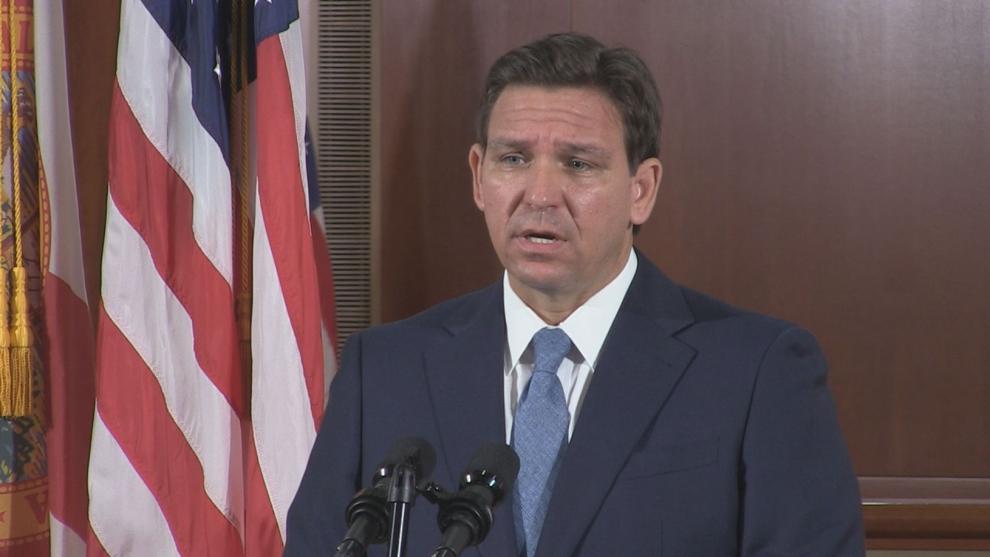
Gov. Ron DeSantis on Monday signed a bill allowing the state to designate groups as “domestic terrorist organizations,” backing up an executive order he issued in December placing that label on two Islamic groups.
The law, which takes effect July 1, bars a court or other adjudicatory body from enforcing any provision of a religious or foreign law, with an emphasis on the Islamic code known as Sharia law.
Another provision allows the state’s chief of domestic security — currently Florida Department of Law Enforcement Commissioner Mark Glass — to designate domestic or foreign terrorist organizations, with approval from the governor and Cabinet.
“The legislation we’ll sign today is the strongest action Florida has ever taken to protect its people from this influence,” DeSantis said during a bill signing event at the University of South Florida’s Gibbons Alumni Center in Tampa. “And obviously, it spans finance, it spans political, it spans culture.”
The legislation (HB 1471) was filed in support of DeSantis’ executive order classifying the Council on American-Islamic Relations, or CAIR, and the Muslim Brotherhood as terrorist organizations.
In March, U.S. District Judge Mark Walker issued a preliminary injunction against the order, writing that it violated CAIR’s rights by targeting and threatening those who provide the organization with material support.
Criticizing the legislation as advancing “a political agenda,” CAIR-Florida Executive Director Hiba Rahim said in a statement Monday that the law jeopardizes student speech, freedom of religion and due process.
“This is not just about CAIR. This expanded and deeply flawed framework can attack any organization that dares to dissent,” Rahim said. “As Floridians, together, we’ll watch how this unprecedented law is enforced, and whether it is used or abused.”
DeSantis acknowledged that Sharia law is not practiced in Florida courts but said the law is intended to prevent its “creep into different institutions.”
“What I see happening in Europe, I see a migration not to assimilate, but to displace the current cultures that are there,” DeSantis said. “We obviously are not going to allow that to happen here in the state of Florida.”
The measure also outlines rules for expelling students at state universities who “promote” support for designated organizations.
If a student’s actions can be “reasonably interpreted” as a threat of violence, a disruption to the learning environment, an infringement on the rights of others or material support or recruitment for such organizations, the student could be expelled under the law.
Other provisions bar schools affiliated with designated terrorist organizations from receiving state K-12 scholarship funding. Public universities and colleges are also prohibited from using state or federal funds to support programs or campus activities that promote such organizations.
The proposal passed in the Republican-controlled Legislature by votes of 80-25 in the House and 25-11 in the Senate.
During debate, Democrats raised concerns that the bill and a related public records exemption (HB 1473), which would block access to documents showing how a terrorist designation is made, could deprive affected groups of due process.
Opponents also warned that people — particularly college students — could be wrongly accused of affiliation with a designated organization and face consequences without a conviction.
 Ali Moreland
  SKYLA CARTER